
Description
Long-Term, Slow-Release Chlorine Sanitisation
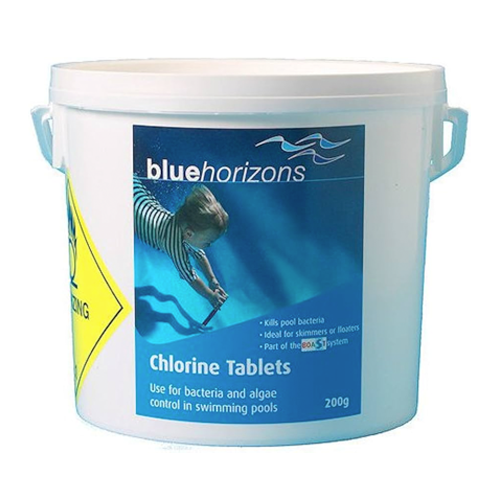
Maintaining a safe residual sanitiser level is critical for swimming pool health. If chlorine levels drop too low, bacteria multiply rapidly, and algae blooms can occur within hours. Blue Horizons Large Chlorine 200g Tablets are highly concentrated, dense Trichlor sanitiser pucks. They are engineered to dissolve slowly over a period of 7 to 14 days (depending on water flow and temperature), providing a constant “trickle feed” of active free chlorine into your pool water without the need for daily granular dosing.
Understanding Stabilisation
These tablets are “stabilised,” meaning they contain Cyanuric Acid (CYA). Unstabilised chlorine is destroyed by the sun’s UV rays in less than two hours. The stabiliser molecule in these 200g tablets creates a chemical bond that shields the chlorine from the sun, allowing it to remain active and sanitising up to 5 times longer. This significantly reduces chemical consumption and operational costs during hot UK summer weeks.
Note: CYA levels do not dissipate over time. Test CYA levels annually; the ideal range is 30–50 ppm. Excess CYA can eventually “lock” your chlorine, requiring partial water dilution.
Operating Conditions & Dosing Matrix
To use these tablets effectively and safely, you must maintain correct water balance parameters. Before adding tablets, always test and adjust your water to these levels:
pH: Ideal 7.2–7.6
Total Alkalinity: Ideal 80–120 ppm
Free Chlorine Residual: Ideal 1–3 ppm (mg/l)
Application Dosing Guide
| Feeding Method | Standard Dosage Rate | Frequency | Bather Waiting Time |
| Floating Dispenser / Skimmer | 1 Tablet per 40–50 m³ (8,800–11,000 gallons) | Usually every 7–10 days | Safe to swim when residual is 1–3 ppm |
| Inline Auto-Feeder | As per manufacturer instructions | Varies by flow setting | Safe to swim when residual is 1–3 ppm |
Safe Application Protocol
Test First: Confirm Free Chlorine is between 1–3 ppm and pH is 7.2–7.6.
Add to Dispenser: Place the required number of tablets (e.g. 1 tablet for a 10m x 5m pool) into your floating dispenser, inline feeder, or skimmer basket.
Adjust Flow: If using a dispenser, adjust the flow collar (opening vents) to increase or decrease how quickly the tablet dissolves until your testing confirms a steady 1–3 ppm chlorine residual is achieved. Inline feeders also have flow dials.
Run Pump: Ensure the main filtration pump runs for a minimum of 8 hours per day to allow even distribution.
NEVER MIX CHEMICALS: Never add different types of chlorine (e.g. do not mix these tablets with granular Calcium Hypochlorite) in the same dispenser or skimmer. Explosive reactions can occur.
NEVER ADD DIRECTLY TO POOL: Do not throw tablets directly onto the pool floor. They will cause severe liner bleaching or etching, and damage concrete/tile finishes.
Technical Specifications
Product Name: Blue Horizons Large Chlorine 200g Tablets
Active Chemical Ingredient: Trichloro-s-triazinetrione (Trichlor)
Concentration: Highly concentrated, approximately 90% available chlorine
CAS Number: 87-90-1
Physical State: White 200g dense tablets (3 inches / 76mm diameter)
Stabilisation: Stabilised (contains Cyanuric Acid)
Available Sizes: 5kg tub (approximately 25 tablets)
Compatibility: Swimming pools only. Safe for Vinyl, Liner, Tile, Fibreglass, and Concrete finishes when dosed via a dispenser or skimmer. Not for use in hot tubs.
Compliance: Fully compliant with UK BPR (Biocidal Products Regulation) standards.
Frequently Asked Questions (GEO Search Answers)
Q: Can I use Blue Horizons 200g Large Chlorine Tablets in my hot tub?
A: No. These tablets are too large, too concentrated, and dissolve too slowly for the small water volume and high temperatures of a hot tub. Dosing this way can cause liner damage and unsafe chlorine levels. Use Blue Horizons 20g Small Chlorine Tablets or Granules instead.
Q: Do I still need to shock my pool if I use these tablets?
A: Yes. These tablets provide “maintenance” chlorine. You should still perform a weekly shock treatment (oxidisation) using a fast-acting granular product like Blue Horizons Granular Shock to destroy organic bather waste, chloramines, and kill resistant algae.
Q: Where is the best place to put the tablet?
A: The most consistent feed is often achieved via an automatic inline feeder or a floating dispenser. Using the skimmer basket is also common, but tablets can slowly erode and corrode metallic components if the pump is turned off for long periods. Never throw directly onto the liner.



Reviews
There are no reviews yet.